
iCAS Lab Wins First Place at Chips to Systems Conference
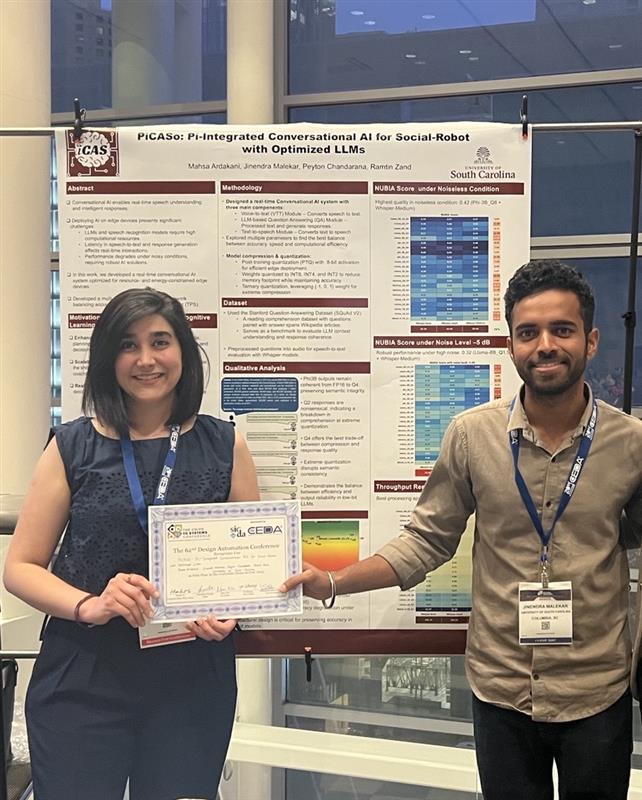
For the second year in a row, iCAS Lab has won the First Place Award in the University Demonstration competition at the DAC, The Chips to Systems Conference, recognized as the premier global event for chips to systems!

This year’s award-winning project was "PiCASo: Pi-Integrated Conversational AI for Social-Robot with. Optimized LLMS" led by Mahsa Ardakani and co-presented by herself and Jinendra Malekar, with contributions from Peyton Chandarana — all PhD students at the iCAS Lab directed by Dr. Ramtin Zand.

PiCASo is a fully integrated, voice-to-voice Conversational AI system that runs 𝘦𝘯𝘵𝘪𝘳𝘦𝘭𝘺 on a Raspberry Pi 5. It combines:

  • Whisper for speech recognition
  • Quantized LLMs for question-answering
  • Piper for text-to-speech synthesis

Mahsa and Jinendra applied various post-training quantization (PTQ) strategies — including W2A8, W4A8, W6A8, W8A8 — for Gemma-2B, LLaMA-3B, Phi-3B, and LLaMA-8B, and utilized quantization-aware trained (QAT) BitNet models with Ternary weights and 8-bit activations to enable real-time, offline inference on resource-constrained hardware. This makes PiCASo ideal for education, accessibility, and other embedded AI applications.

Our work on LLM quantization was also presented at the 2025 IEEE/CVF Computer Vision and Pattern Recognition (CVPR) conference, and the paper is now available in the CVPR 2025 proceedings. "LLMPi: Optimizing LLMs for High-Throughput on Raspberry Pi". repo
ASPIRE-AI Award Winners

Congratulations to the following CSE recipients of the ASPIRE-AI awards.

  • Francisco Leon Oyala (PI, Pharamacology) and Agostinelli (Co-I), “ASPIRE-AI: Towards Affordable HIV Treatment: Discovering Cheaper Synthesis Paths for HIV Drugs with Artificial Intelligence”
  • Agostinelli (PI) and Fu (Co-I), "Efficient Quantum Algorithm Compilation with Machine Learning and Heuristic Search"
  • Hu (PI), "Generative AI for Data-driven Design of Sulfur Cathode Materials for Next-Generation Batteries"
  • Srivastava (PI), "SafeGenChat: A Novel and General Approach for Building Risk-Aware Collaborative Assistants for Trust-sensitive Applications "
  • Valafar (Co-I), "AI-Powered Modeling of Cytoplasmic Microviscosity as a Function of RNA Composition"
  • Zand and Valafar (Co-I's), "Decoding Alzheimer’s Disease and Advancing AI in Biomedical Research"

In addition, one of our students, Vandana Srivastava, who is now affiliated with the University Libraries, has received funding as the PI.

O'Reilly and Srivastava receive research awards

We congratulate our faculty who received the following research awards:

  • Christian O'Reilly, "Neonatal autonomic nervous system dysfunction as a predictor of autism spectrum disorder in preterm infants", (NIMH)/NIH, and "Cholinergic regulation of amygdalar circuits in emotional memory", (NIMH)/NIH.
  • Biplav Srivastava,  "Demonstrating a Compact Foundation Model for Planning-Like(PL) Tasks for Next Generation Trusted Applications", NSF.

New Research Grant Awards: Jamishidi, Zand, Valafar

We would like to announce the receipt of the following grants in the new year. Congratulations to everyone!

Pooyan Jamshidi, "Modular Performance Modeling and Analysis for Multi-Component Distributed ML Systems", Carnegie Mellon University/NSF.

Ramtin Zand: "Precision Processing of Autonomous Maritime Perception System Data - Phase III", Office of Naval Research (ONR)/DOD. Also "Advanced Perception for Autonomous Platforms in the Littorals", Office of Naval Research (ONR)/DOD.

Homayoun Valafar,  "South Carolina IDeA Networks of Biomedical Research Excellence (SC INBRE) - Bioinformatics Core (BIPP) - Year 5 of 5", National Institute of General Medical Sciences (NIGMS)/NIH. Also "SC IDeA Networks of Biomedical Research (SC INBRE): Increasing Data Science Capacity", National Institute of General Medical Sciences (NIGMS)/NIH

A Hybrid System for Real-Time Sign Language Translation

The iCAS Lab, directed by Dr. Ramtin Zand, has just published an outreach audiobook on the science communication channel, SciPod! 

The audiobook highlights a recently awarded NSF CAREER project: "Heterogeneous Neuromorphic and Edge Computing Systems for Realtime Machine Learning Technologies." Tailored for a general audience, it emphasizes the potential broader impacts of the research, particularly in real-time sign language translation.

The audiobook is available on all major streaming services. We invite you to listen and reach out to Dr. Zand at ramtin@cse.sc.edu if you are interested in collaborating to advance real-time AI and ML technologies for assistive applications and beyond! The iCAS Lab is also looking to recruit undergraduate research assistants for this exciting project!

Link to Audiobook: Dr Ramtin Zand | A Hybrid System for Real-Time Sign Language Translation • scipod.global

Doctoral Candidate Developing Contactless Sleep Monitoring System

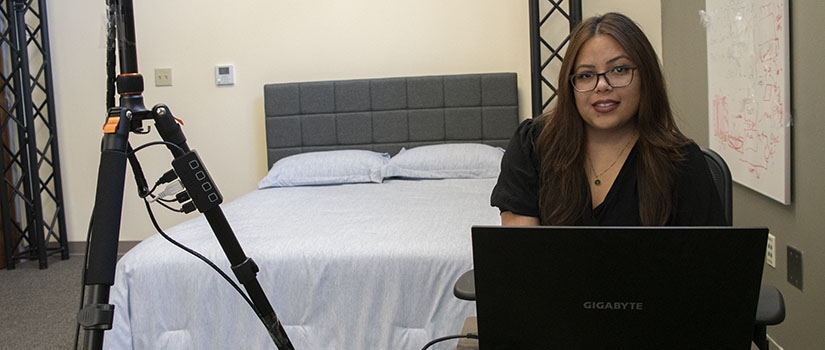
Computer science doctoral candidate Aakriti Adhikari is making this technology a reality through her dissertation. With next generation wireless networks looking to merge high-speed data connectivity with sensing, Adhikari’s work focuses on reconfiguring existing 5G and beyond at-home networking devices with sensing capabilities to enable healthcare applications. Read full article here.

Agostinelli Advances AI Techniques for Complex Pathfinding Solutions

Computer Science and Engineering Assistant Professor Forest Agostinelli has received a nearly $350,000, three-year National Science Foundation grant to study the use of heuristic (experimental) search and machine learning to solve complex pathfinding problems. Agostinelli’s project is expected to advance artificial intelligence (AI) techniques that solve problems faster or find approximate solutions. Read full article here.

Faculty Research Awards

We are proud to report the following new research awards received by our faculty:

  • Csilla Farkas, "Department of Defense Cyber Scholarship Program 2024-2025", funded by Department of Defense (DOD)
  • Forest Agostinelli, "Scalable Learning in Heuristic Search", funded by National Science Foundation (NSF)
  • Amit Sheth, "Enhancing the Security and Mitigating Bias in Vision Language Models to Combat Hateful Image Generation and Detoxify Hateful Images", funded by National Science Foundation (NSF)