Checkout our website for prospective students.

Capstone Projects Showcase 2026

This year the students in the Senior Capstone course developed 39 apps. There are:

  • 23 web applications using technologies such as Django, node, express, Angular, react, Vue, firebase, AWS.
  • 8 Android or iOS mobile apps using technologies such as Android Studio, Flutter, React Native, XCode, Firebase.
  • 8 desktop games using technologies such as Unity, GameMaker.

You can view their video demos here. If you want a custom-made app, let us know!

USC Computer Scientists Solve a Stubborn AI Problem That Has Long Frustrated Experimental Scientists

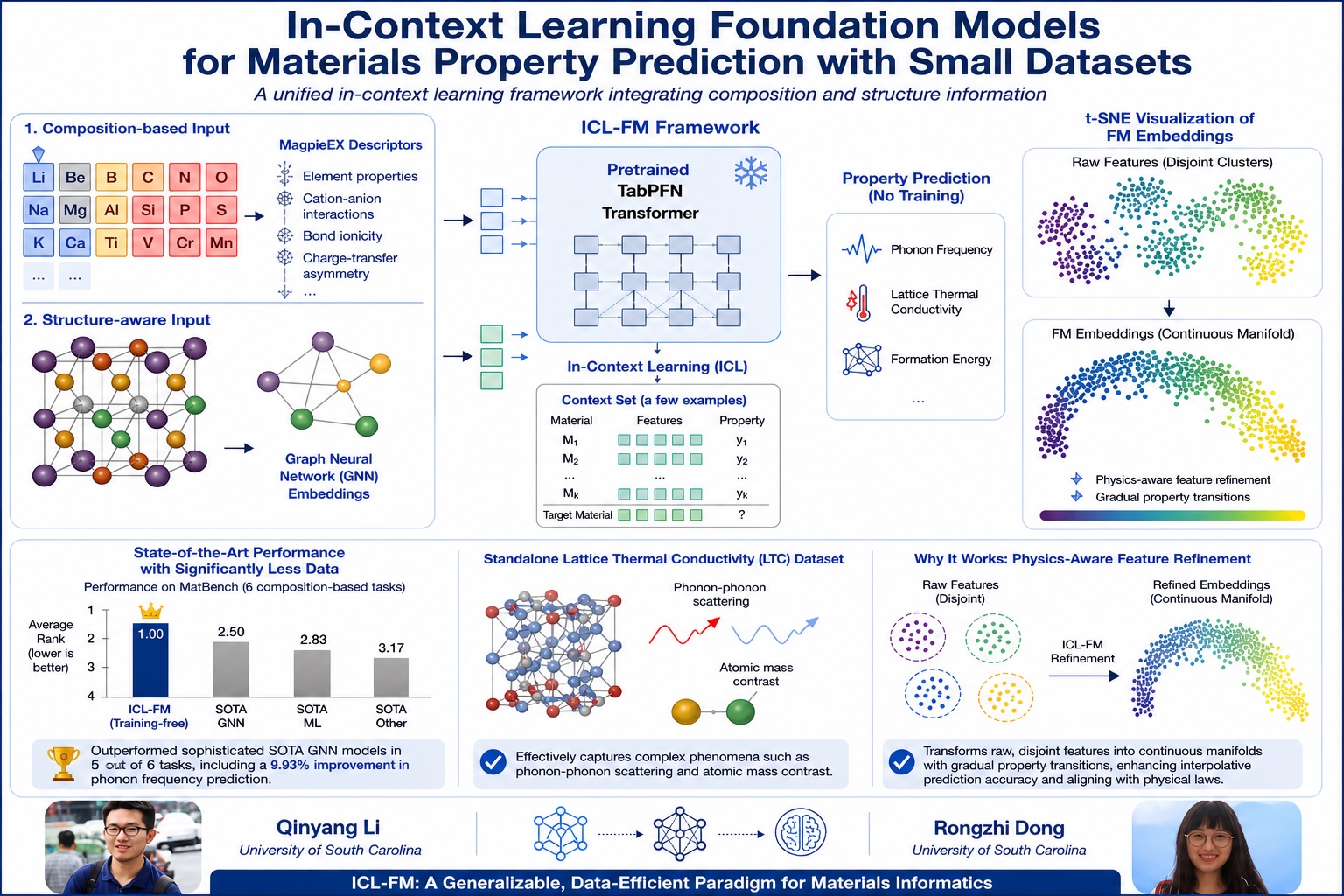
IC-FM FrameworkOne of the most frustrating realities in experimental science is deceptively simple: running experiments is expensive. Synthesizing a new material, testing a drug candidate, or measuring a physical property can cost thousands of dollars and weeks of laboratory time. As a result, scientists often have only a few dozen data points to work with — far too few for conventional AI models, which typically need thousands or millions of examples to make reliable predictions.

A new study from the University of South Carolina's Department of Computer Science and Engineering has found a way around this fundamental bottleneck. Published in npj Computational Materials — one of the world's top materials science journals from the prestigious Nature family of publications, with an impact factor of 9.5 — the research introduces a new AI framework called ICL-FM (In-Context Learning Foundation Model) that can predict material properties accurately even when trained on tiny datasets, and in many cases requires no training at all.

The Core Idea: Teaching AI to Learn from Context, Not Volume

The key insight borrows from how large AI systems like ChatGPT work. These so-called "foundation models" are pretrained on enormous amounts of general knowledge, then given a handful of relevant examples at the moment they need to answer a question — a technique called in-context learning. Prof. Jianjun Hu's team asked: could this same strategy work for scientific property prediction, where data is scarce by nature?

The answer, it turns out, is a resounding yes. ICL-FM combines a pretrained transformer model (TabPFN) with specialized representations of material chemistry, including a new descriptor system the team developed called MagpieEX. MagpieEX captures how atoms bond and exchange charge within a material — information critical for predicting properties like how well a material conducts heat or vibrates at the atomic level.

Outperforming Larger Models with Far Less Data

The results are striking. Tested on MatBench — the standard benchmarking suite for materials property prediction — ICL-FM matched or outperformed state-of-the-art graph neural network models on five out of six composition-based tasks, including a nearly 10% improvement in predicting phonon frequencies, which govern how heat moves through a solid. Crucially, it achieved this in a completely training-free mode: the model was never specifically trained on materials data at all.

The team also showed that ICL-FM's internal representations are physically meaningful. Rather than treating atomic features as disconnected data points, the model organizes them into smooth, continuous patterns that mirror real physical laws — a property the researchers confirmed using a visualization technique called t-SNE analysis.

Why This Matters Beyond Materials Science

The implications extend well beyond predicting how metals or crystals behave. The small-data problem is universal in experimental science.

In drug design, identifying which molecule will bind effectively to a disease target — without synthesizing thousands of compounds — is one of the field's hardest challenges. In chemistry, predicting how a reaction will proceed from limited experimental observations could dramatically speed up catalyst development for clean energy. In physics, characterizing exotic quantum materials requires painstaking measurements that yield only sparse datasets. In each of these fields, an AI system that performs well with limited data is not just convenient — it is transformative.

ICL-FM's architecture is built to generalize. The same framework that predicts thermal conductivity in crystals today could, with appropriate material representations, be adapted to molecular property prediction in pharmaceuticals, reaction yield prediction in synthetic chemistry, or property forecasting in semiconductor design.

A New Paradigm for Materials Informatics

"This work establishes a new paradigm for data-efficient AI in materials science," said Prof. Jianjun Hu, the study's corresponding author and a faculty member in USC's Department of Computer Science and Engineering. The research was supported by the National Science Foundation.

The study's first authors, Qinyang Li and Rongzhi Dong, are PhD students in the department, alongside co-authors Nicholas Miklaucic, Sadman Sadeed Omee, Lai Wei, and Sourin Dey. The team also collaborated with Jeffrey Hu from the University of Illinois Urbana-Champaign and Prof. Ming Hu from USC's Department of Mechanical Engineering. This research was funded by the National Science Foundation.

The paper is open access and freely available at nature.com.

iCAS Undergraduate Researchers Earn First Place at USC Discover

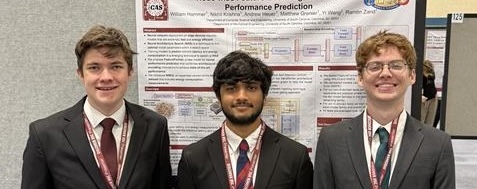
Andrew Heuer, Ethan Hammer, and Nikhil Krishna, undergraduate researchers in the iCAS Lab, earned first place in the Engineering and Computing track at USC Discover for their project, “Node-wise Feature Encoding for Neural Performance Prediction.” Mentored by fellow iCAS Lab graduate member Matthew Grenier.
Their work addresses the challenge of accurately predicting latency and energy for neural networks deployed on resource-constrained edge devices. They introduced FeatureFormer, a neural performance predictor that integrates node-level information, such as FLOPs, parameter counts, and memory usage, into a graph attention framework, along with a large-scale dataset for evaluating energy consumption.

This work was supported by the Office of Naval Research (ONR) and the National Science Foundation (NSF), whose funding was instrumental in enabling the project’s development and success.

South Carolina AI4Science Summer Camp 2026

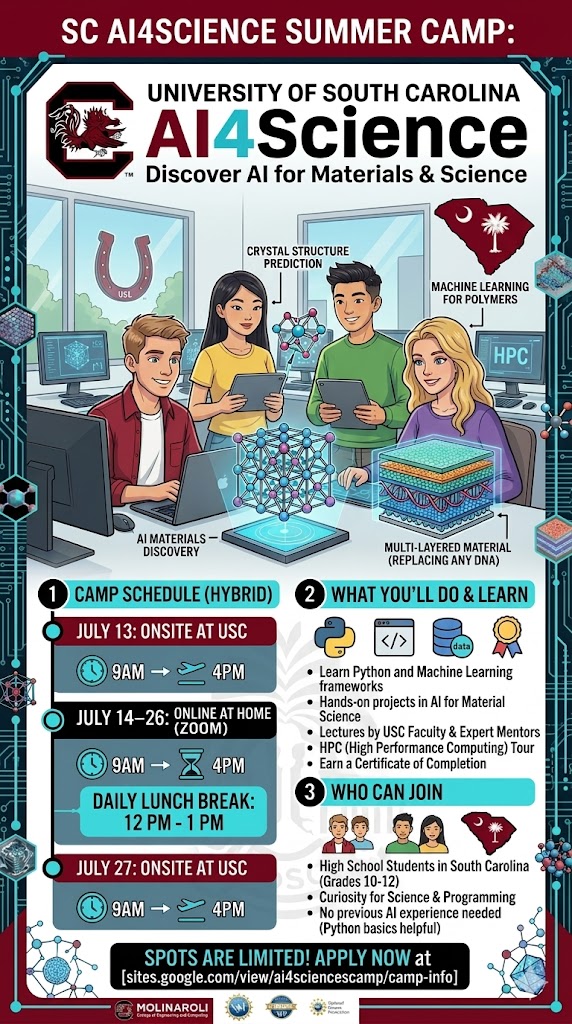
The South Carolina AI4Science Summer Camp 2026 is open for application. This camp is meant to introduce students to AI and scientific discovery with the help of lectures, tutorials, and most importantly hands-on activities. The objective is to actively engage and inspire the students. Students should come in with some Python programming experience, curiosity, and enthusiasm to learn!

This AI4Science summer camp is FREE and made possible by National Science Foundation, the sponsorship of College of Engineering and Computing and College of Arts and Sciences of University of South Carolina (USC) and by our commitment to broad impact efforts as encouraged by the National Science Foundation Major Research Instrumentation (MRI) Program under Award 2320292, "Track 2 Acquisition of a High-Performance Computing Cluster for Boosting Artificial Intelligence Enabled Science, Engineering, and Education in South Carolina". Apply here.

Outstanding Senior Awards

Each year the Faculty of the Department of Computer Science and Engineering (CSE) award four Outstanding Senior Awards. This process is never easy given the many excellent and accomplished students in our program. This year, the Computer Science and Engineering Outstanding Senior Awards go to:

  • Abhinav Krishniah: Computer Science Outstanding Senior Award
  • Brandon Wells: Computer Engineering Outstanding Senior Award
  • Rye Stahle-Smith: Computer Engineering SCSPE Award
  • Eva Wilson: Computer Information Systems Outstanding Senior Award

awardees will be honored at the University Awards Day ceremony.

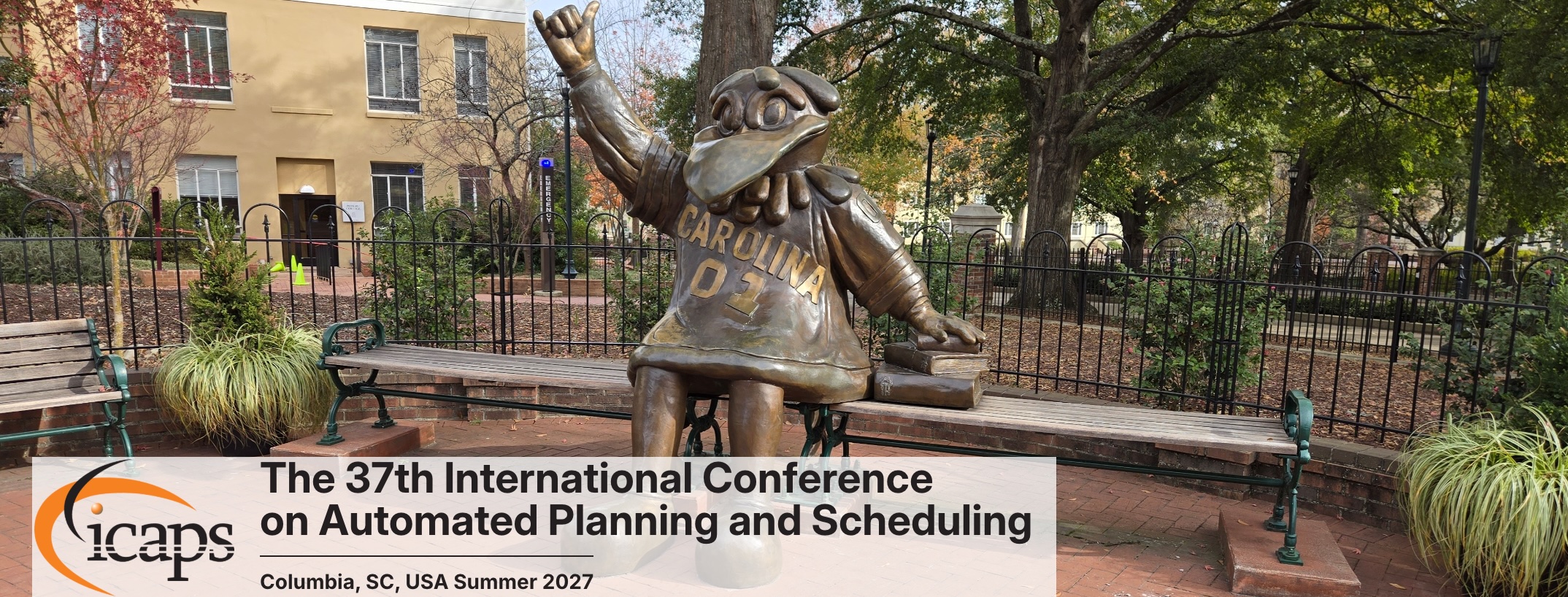
Srivastava and Agostinelli to Chair AI Conference in Columbia SC

ICAPS 2027

Dr Biplav Srivastava and Dr Forest Agostinelli are the general chairs of the 37th instance of a leading AI conference, International Conference on Automated Planning and Scheduling (ICAPS), and they are bringing it to Columbia, SC in the summer of 2027. This conference attracts 200-300 researchers from around the world and is coming to the south-east US for the first time.

For more details about ICAPS and ICAPS-2027, see https://icaps27.icaps-conference.org/

Graduate researcher advances machine learning research

Computer Science Ph.D. student Misagh Soltani is passionate about artificial intelligence. As a graduate researcher at the Artificial Intelligence Institute of USC (AIISC), he channels his passion into furthering model-based deep reinforcement learning. It is work he hopes will make tasks easier and information more accessible for the betterment of society.

Reinforcement learning is a branch of machine learning where an agent interacts with an environment and learns, through trial and error, how to make decisions to efficiently achieve the desired goals. Reinforcement learning approaches can be used in a variety of domains from manufacturing, where it optimizes robot motion and automation, to the natural sciences. Read the full story here.

Quantum Computing Workforce Development in the New Era of Computing

The Computer Science and Engineering Department has received a grant from the National Science Foundation to launch a new Research Experiences for Undergraduates (REU) Site, "Quantum Computing Workforce Development in the New Era of Computing." Led by Dr. Stephen Fenner with co-principal investigators Dr. Homayoun Valafar and Dr. Peng Fu, the program brings together faculty from Computer Science and Mathematics to prepare the next generation of quantum innovators. Partnering with SC Quantum and the Boyd Innovation Center, the initiative will offer undergraduate students from across the nation a nine-week summer research experience exploring cutting-edge topics such as quantum software testing, AI-driven quantum compiler optimization and quantum machine learning. Through hands-on research, mentorship, and professional development, the program aims to strengthen the national quantum workforce and expand opportunities for students in this rapidly evolving field.

USC Team Jiarong Xu and Bose Kaikini win Quantum Machine Learning Challenge

Two of our students, Jiarong Xu and Bose Kaikini, together with their collaborator Bailey Yu from Amherst College, have won first place in the Quantum Machine Learning Challenge Track of Quantathon V2 – International Quantum Hackathon. The competition brought together nearly 100 participants from 8 countries and 37 institutions, all mentored by experts from academia and industry. The team developed an innovative quantum machine learning model and successfully conducted experiments on a real quantum computer, showcasing the exciting intersection of quantum computing and artificial intelligence. This event also served as the championship round of the International Quantum Circuit, held as part of the United Nations’ International Year of Quantum Science and Technology.
Entrepreneurial Ph.D. candidate develops AI models for use in healthcare, social connection

In 2016, Computer Science Ph.D. candidate Alireza Bagheri first realized that artificial intelligence would change the world. Two years after receiving his bachelor’s degree in electrical and electronics engineering from Guilan University in Iran, Bagheri began studying for his master’s degree at the University of Akron in Ohio. While there, he co-founded tech startup G-Angel to develop an AI-powered device which could automatically place a catheter into a patient’s blood vessel.

“G-Angel was born from a desire to improve healthcare,” Bagheri says. “Today, I’m continuing in the same direction, designing AI to analyze the vascular system.”  Read the rest of the story here.

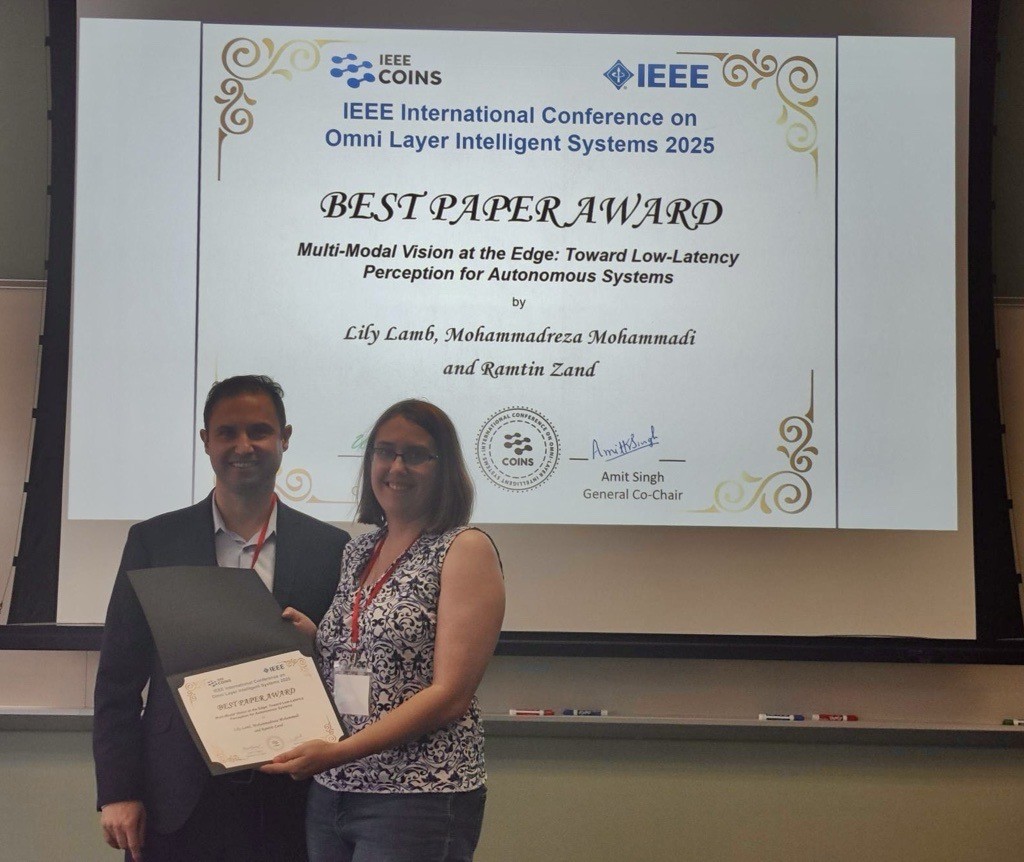
iCAS Lab wins the Best Paper Award at IEEE COINS 2025 Conference

The iCAS Lab Ph.D. Students, Lily Lamb and MohammadReza Mohammadi, have received the Best Paper Award at the IEEE COINS 2025 Conference.

Their paper, which is part of a project funded by the NSF CAREER program, explores how to enable real-time perception in autonomous systems under real-world conditions. "MultiModal Vision at the Edge: Toward Low-Latency Perception for Autonomous Systems", by Lily Lamb, Mohammadreza Mohammadi, and Ramtin Zand.

Abstract: The paper introduces an extended YOLOv8 framework that fuses RGB, LiDAR-based depth, and grayscale inputs using early, mid, and late fusion strategies, optimized for edge AI platforms. To support real-time processing, the team developed a parallelized depth generation pipeline that transforms sparse LiDAR point clouds into dense maps. Evaluated on the KITTI dataset and benchmarked across Raspberry Pi 5, Jetson Nano, and Google Coral Edge TPU, the models reveal the trade-offs between accuracy and latency, where late fusion delivers the highest accuracy (mAP@50: 92.7%), and early fusion achieves the lowest latency.

See in the dark

A see-in-the-dark monitoring and navigational system intended to improve safety in underground mines is being developed by a University of South Carolina computer science and engineering team in collaboration with researchers in India.

Sanjib Sur, an associate professor in the Molinaroli College of Engineering and Computing, is helping design a system that uses millimeter-wave technology to provide real-time monitoring in underground mines. The three-year project is co-funded by the National Science Foundation and India’s Department of Science and Technology. Read full story here.

AI meets medicine

The medical school  partnered last year with the Molinaroli College of Engineering and Computing to launch the AI in Medicine Extracurricular Track, an interdisciplinary pilot program with eight lectures — the first of which is required for all medical students — intended to give first- through third-year medical students a better understanding of how AI works and how it can be used in health care. The inaugural cohort of 10 students has completed its first year and a second cohort will be selected this summer.

Homayoun Valafar, chair of the computer science and engineering department and director of USC’s AI Institute, is co-directing the AI in Medicine initiative with Leonardo Bonilha, a neurology professor and the medical school’s senior associate dean for research. Valafar likens AI to a device like others used in medicine such as stethoscopes and handheld ultrasound. Read the full article here.

USC CSE Department Chair Search

The Department of Computer Science and Engineering (CSE) at the University of South Carolina invites applications for the position of Department Chair. This is a leadership role for an individual with a strong vision for the future of computer science and engineering education and research, as well as a deep commitment to faculty development and student success.

The Department Chair will serve as the academic and administrative leader of the department, providing strategic direction, fostering collaboration, and supporting a vibrant community of scholars, educators, and students. The Chair will guide the department in defining and expanding areas of core strengths, promoting interdisciplinary sponsored research, and ensuring the highest standards of academic excellence. More details and application here.

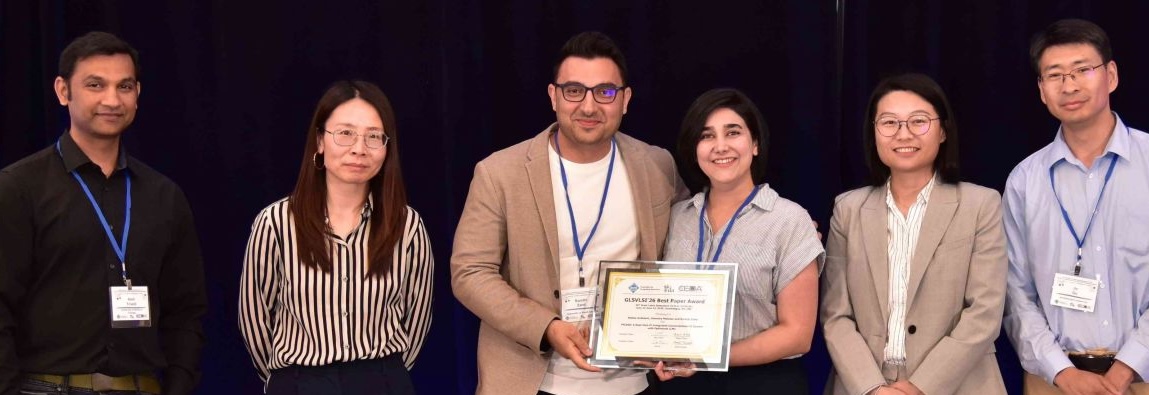
Best Poster Award for Md Hasibul Amin and MohammadReza Mohammadi

The iCAS Lab Ph.D. students, Md Hasibul Amin and MohammadReza Mohammadi have received the Best Poster Award at the GLSCLSI 2025 Conference—a premier venue for disseminating research in VLSI, devices, and system-level design. Earlier this year, this work also earned second place at the CSE Research Symposium.

This is a collaborative work between Dr. Ramtin Zand's lab and Dr. Jason Bakos on a project funded by the National Science Foundation (NSF).

"CrossNAS: A Cross-Layer Neural Architecture Search Framework for PIM Systems", by  Md Hasibul Amin, MohammadReza Mohammadi, Jason Bakos, and Ramtin Zand

Abstract: This work introduces the CrossNAS framework, an automated approach for exploring a vast, multidimensional search space that spans various design abstraction layers—circuits, architecture, and systems—to optimize the deployment of machine learning workloads on analog processing-in-memory (PIM) systems. CrossNAS leverages the single-path one-shot weight-sharing strategy combined with the evolutionary search for the first time in the context of PIM system mapping and optimization. CrossNAS sets a new benchmark for PIM neural architecture search (NAS), outperforming previous methods in both accuracy and energy efficiency while maintaining comparable or shorter search times.