Duncan A. Buell
Professor
Department of Computer Science and Engineering
University of South Carolina
Columbia, SC 29208
3A69 Swearingen
Email
803-777-7848(voice)
803-777-3767(fax)
Office hours: TBA
grizzlefarb

Why Study Computing?

In answer to the question, I prepared a document based on statistics about job prospects and degree production.

Advanced Placement Summer Institute for Computer Science Teachers

Unfortunately, the AP Summer Institute will not be held due to low enrollment. We will try again next year.

Education

B.S.: Mathematics, University of Arizona, Tucson, 1971
M.A.: Mathematics, University of Michigan, Ann Arbor, 1972
Ph.D.: Mathematics, University of Illinois--Chicago, 1976
Complete resume (pdf)
I am nerdier than 98% of all people. Are you nerdier? Click here to find out!

Research

Digital humanities
Electronic voting systems
Nonnumeric computations
Computational number theory
Parallel computing
Information retrieval
ACM Transactions on Reconfigurable Technology and Systems

Teaching

Using Moodle
The CSE department Moodle site
CSCE146: Introduction to Algorithmic Design II (Fall2011)
CSCE551: Theory of Computation (Summer 1 2011)
CSCE146: Introduction to Algorithmic Design II (Spring2011)
CSCE240: Introduction to Software Engineering (Spring2010) (Fall2009)

Bio

I am a Professor in the Department of Computer Science and Engineering at the University of South Carolina. I am also a consulting faculty member in the Linguistics program.

Supporting Computer Science:

Much of my time these days is spent on behalf of computer science, the discipline, by working in South Carolina and nationally to ensure that computer science is "marketed" properly to the public, especially in the K-12 school system. I am the national university faculty representative to the board of the Computer Science Teachers Association and was part of the organization of a chapter of CSTA here in South Carolina.

Digital Humanities:

I have recently moved into the digital humanities, including gaming in the humanities, and am working with scholars there and with students here to build out a educational game for early modern British history and for language and morpheme learning.

Electronic Voting Systems:

I have also been working since 2004 (details can be found here) with the League of Women Voters of South Carolina on the subject of electronic voting machines. Most recently, a group of citizens has conducted an audit of the June 2010 primary and the November 2010 general elections, with some disturbing conclusions. This link discusses only what we have found in Richland County; we have found similar problems in nearly every other county we have audited.

Past Lifetimes:

In the past my principal research interests were the algorithms and architectures for performing computations, such as those in discrete mathematics and text/string processing, for which traditional computer architectures oriented toward floating-point computations normally perform at a significantly reduced efficiency. One class of such problems are those computational problems in number theory for which fast integer arithmetic, often multiprecision arithmetic, is necessary. Another broad class of problems are those for which "custom computing machines" were devised. These include bit-oriented computations such as those done in string processing, and image processing computations, for which one often needs substantial parallelism, but for which 8-bit or 12-bit arithmetic is often sufficient accuracy.

I was an instructor in mathematics at Carleton University in Canada (1976-77), a faculty member in computer science at Bowling Green State University (1977-1979) and Louisiana State University (1979-1985), and a member of the research staff at the Center for Computing Sciences of the Institute for Defense Analyses (1986-2000). Among other things at IDA/CCS I directed the Splash 2 project building a custom computing machine that used Xilinx FPGAs as the compute elements and whose applications were programmed in VHDL. Commercialized versions of and variations on Splash 2 are available from several vendors, including Annapolis Microsystems, Inc. (with whom I have no financial connections whatsoever). As part of popularizing the concept of custom computing machines, we created a conference, held annually since 1993, now called the IEEE Symposium on Field-Programmable Custom Computing Machines (www.fccm.org).

Some comments and links elsewhere

I have been involved in various ways since the the beginning of the the FCCM conference in reconfigurable computing. This is one of two major U.S. conferences on the use of programmable gate arrays in computation.

I am also concerned with U.S. education in the STEM (science, technology, engineering, and mathematics) fields, and I have been involved as it seemed necessary for more than 25 years in defending science education against attacks from supporters of nonscience, pseudoscience, and the occasional downright fraudulent dishonesty. In that spirit I commend to the reader the award-winning website of the National Center for Science Education, the Talk dot Origins website and its award-winning subsite Panda's Thumb, the almost unbelievably clear prose of the Kitzmiller decision, the website information from the American Association for the Advancement of Science, the National Science Teachers Association, the National Academies, the Federation of American Societies for Experimental Biology, and from South Carolinians for Science Education. The science standards in South Carolina require that students learn how it is that scientists go about a "critical analysis" of that which is to be considered science. These websites can provide that information. As is indicated by the recent press release and position statement by the Interacademy Panel on International Issues representing many of the world's science academies, that critical analysis has clearly been done and the conclusions (at least at the level of K-12 science education) are clear as to what students need to learn.

I grew up and went to high school on the north shore of Lake Pontchartrain. Much of my family still lives there, so I have a strong personal interest in the effects of Hurricane Katrina and the attempts to rebuild New Orleans in such a way that a colossal failure of "the system" could not happen again.

I have also found the Big Word Project to be amusing, so I bought the word ``curmudgeon.''

In addition to the above, I update from time to time some other links of possible interest.

Finally, let's get real. It is irresponsible as a technical person and morally reprehensible as a human being to advocate on behalf of nuclear energy unless and until we have shown ourselves capable as a nation and a society of dealing with the environmental fallout (no pun intended) of the use of nuclear power. Nuclear power is the environmentally most destructive of all methods of generating power because there is nothing to mitigate the hopeless physics of half-life and decay. We have, in the United States, demonstrated over the last several decades that we cannot sustain a policy with regard to nuclear waste for even as much as two presidential terms. Given that nuclear waste must be stored for somewhere between hundreds and tens of tthousands of presidential terms, it becomes untenable to argue that we in any sense of the word "ought" to be using nuclear power as anything but a stopgap to be rid of as soon as possible.

Publications

Books and Proceedings

D. A. Buell and K. Pocek, eds., Proceedings of the IEEE Symposium on Field-Programmable Custom Computing Machines, IEEE Computer Society Press, 2008.

D. A. Buell and K. Pocek, eds., Proceedings of the IEEE Symposium on Field-Programmable Custom Computing Machines, IEEE Computer Society Press, 2007.

D. A. Buell and K. Pocek, eds., Proceedings of the IEEE Symposium on Field-Programmable Custom Computing Machines, IEEE Computer Society Press, 2006.

D. A. Buell, ed.,Algorithmic Number Theory, Proceedings of the sixth international symposium (ANTS VI), Lecture Notes in Computer Science 3076, Springer-Verlag, 2004.

D. A. Buell and J. T. Teitelbaum, eds., Computational Perspectives A Number Theory: Proceedings of a conference in honor of A. O. L. Atkin, American Mathematical Society, 1997.

D. A. Buell, J. M. Arnold, and W. J. Kleinfelder, eds., Splash 2: FPGAs in a Custom Computing Machine, IEEE Computer Society Press, 1996.

D. A. Buell and K. Pocek, eds., Proceedings of the IEEE Workshop on FPGAs for Custom Computing Machines, IEEE Computer Society Press, 1994.

D. A. Buell and K. Pocek, eds., Proceedings of the IEEE Workshop on FPGAs for Custom Computing Machines, IEEE Computer Society Press, 1993.

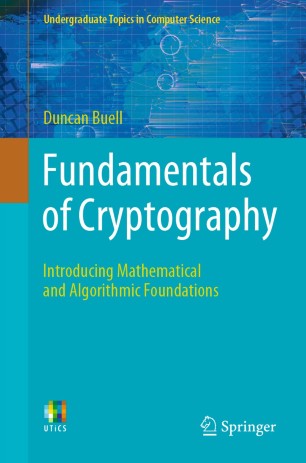
D. A. Buell, Binary Quadratic Forms: Classical Theory and Modern Computations, Springer-Verlag, 1989.


Journal and Conference Publications

T. El-Ghazawi, E. El-Araby, M. Huang, K. Gaj, V. Kindratenko, D. Buell, "The promise of high-performance reconfigurable computing," IEEE Computer, February 2008, pp. 69-76.

Y. Kopylova, D. A. Buell, C.-T. Huang, and J. Janies, "Mutual information applied to anomaly detection," Journal of Communications and Networks, v. 10, 2008, pp. 89-97.

S. Shida, Y. Shibata, K. Oguri, and D. A. Buell, "Implementation of a barotropic operator for ocean model simulation using a reconfgurable machine," Proceedings, FPL, August 2007.

D. A. Buell, "Number theory," The Handbook of Information Security, Volume 2, John Wiley, 2006, pp. 532-547.

D. A. Buell, "The Advanced Encryption Standard," The Handbook of Information Security, Volume 2, John Wiley, 2006, pp. 498-509.

D. A. Buell, S. Akella, J. P. Davis, G. Quan, and D. Caliga, "The DARPA boolean equation benchmark on a reconfigurable computer," Proceedings, Military Applications of Programmable Logic Devices (MAPLD),Washington, DC, 8-10 September 2004.

D. A. Buell, J. P. Davis, G. Quan, S. Akella, S. Devarkal, P. Kancharla, E. A. Michalski, and H. A. Wake, "Experiences with a reconfigurable computer," Proceedings, Engineering of Reconfigurable Systems and Algorithms, Las Vegas, Nevada, 21-24 June 2004.

D. A. Buell and R. Sandhu, "Identity management," IEEE Internet Computing, v. 7, no. 6, November/December 2003, pp. 26-28 (guest editors' introduction).

P. Kancharla and D. A. Buell, "The Advanced Encryption Standard on the HC-36m reconfigurable computer," Proceedings, Military Applications of Programmable Logic Devices (MAPLD),Washington, DC, 9-11 September 2003.

S. Akella, D. A. Buell, J. P. Davis, and H. A. Wake, "Porting EDIF netlists to the Viva environment," Proceedings, Military Applications of Programmable Logic Devices (MAPLD),Washington, DC, 9-11 September 2003.

D. A. Buell, S. Devarkal, and H. A. Wake, "Reconfigurable computing machines and their applications in computational number theory," High Primes and Misdeameanours: A Conference in Honor of Hugh Williams, Fields Institute Communications, v. 41, Fields Institute, Toronto, pp. 123-148. (ppt)

D. A. Buell and G. S. Call, "The ideal class pairing and isogenies of elliptic curves," submitted.

X. Feng, D. A. Buell, J. R. Rose, and P. J. Waddell, "Parallel algorithms for Bayesian phylogenetic inference," Journal of Parallel and Distributed Computing, v. 63, 2003, pp. 707-718.

D. A. Buell and H. A. Wake, "Congruential sieves on a reconfigurable computer," Proceedings, FCCM 2003, pp. 11-18.

D. A. Buell and J. P. Davis, "Reconfigurable computing applied to problems in communications security," Proceedings, Military Applications of Programmable Logic Devices (MAPLD),Laurel, Maryland, 10-12 September 2002.

M. N. Huhns and D. A. Buell, "Trusted autonomy," IEEE Internet Computing ,v. 6, no. 3, May/June 2002, pp. 92-95.

D. A. Buell, C. Farkas, M. N. Huhns, J. R. Rose, M. G. Valtorta, "Information reputation in an environment of ubiquitous computing," Phoenix Conference on Information Warfare, Colorado Springs, Colorado, September 2001.

D. A. Buell, "The last exhaustive computation of class groups of complex quadratic number fields," CRM Proceedings and Lecture Notes, v. 19, 1999, pp. 35-53.(Proceedings of the Fifth Conference of the Canadian Number Theory Association.)

D. A. Buell and Kenneth L. Pocek, "Custom computing machines: An introduction," The Journal of Supercomputing, v. 9, 1995, pp. 219-230.

N. D. Bronson and D. A. Buell, "Congruential sieves on FPGA computers,"in Proceedings of Symposia in Applied Mathematics #48,Walter Gautschi, editor, American Mathematical Society, Providence,1995, pp. 547-552.

J. M. Arnold and D. A. Buell, "VHDL programming on Splash 2," in More FPGAs, Will Moore and Wayne Luk, editors, Abingdon EE & CS Books, Oxford, England, 1994, pp. 182-191. (Proceedings,International Workshop on Field-Programmable Logic, Oxford, 1993.)

J. M. Arnold, D. A. Buell, D. Hoang, D. V. Pryor, N. Shirazi, M. R. Thistle, "Splash 2 and its applications, "Proceedings, International Conference on Computer Design, Cambridge,1993, pp. 482-486.

J. Young and D. A. Buell, "The twentieth Fermat number is composite," Mathematics of Computation, v. 50, 1988, pp. 261-263.

D. A. Buell, "Factoring: Algorithms, computers, and computations," The Journal of Supercomputing, v. 1, 1987, pp. 191-216.

D. M. Chiarulli and D. A. Buell, "Parallel microprogramming tools for a horizontally reconfigurable architecture," International Journal of Parallel Programming, v. 15, 1986, pp. 151-162.

D. M. Chiarulli, W. G. Rudd, and D. A. Buell, "DRAFT---A dynamically reconfigurable processor for integer arithmetic," Proceedings,7th International Symposium on Computer Arithmetic, Urbana, Illinois, 1985, pp. 309-317.

D. H. Kraft and D. A. Buell, "Fuzzy sets and generalized Boolean retrieval systems," International Journal of Man-Machine Studies, v. 19, 1983, pp. 45-56.(Reprinted in Readings in Fuzzy Sets for Intelligent Systems, Didier Dubois, Henri Prade, and Ronald Yager, eds., San Mateo: Morgan Kaufmann, 1993.)

D. A. Buell, "A general model of query processing in information retrieval systems," Information Processing and Management, v. 17, 1981, pp. 249-262.

D. A. Buell, "Elliptic curves and class groups of quadratic fields," Journal of the London Mathematical Society, Series 2, v. 15, 1977, pp. 19-25.

Swearingen Engineering Center | Columbia, SC 29208 | 803.777.2880 | web@cse.sc.edu